 how-to
How to Fix a Gap at the Bottom of Your Garage Door
Last Updated: November 7, 2026
Quick Summary
A garage door gap at the bottom is usually caused by a worn bottom seal, an uneven concrete floor, or an opener set to stop too high. Start by finding where the light leaks through, then match the fix to the cause. Replacing a worn seal typically takes about 1 to 2 hours.
- Check for light with the garage lights off and a flashlight inside while you look from outside.
- An even gap across the whole bottom usually points to a worn seal or a door set too high.
- A gap wider at one end usually points to an uneven floor rather than the seal.
- Measure the gap at the highest and lowest points to see whether the floor is the problem.
- Never adjust travel limits with the door open and unsupported; disconnect the opener and keep hands away from springs.
Table of Contents
- Why a Gap Under Your Garage Door Matters
- Diagnose Where the Gap Is Before You Start
- Fix an Uneven Gap at Bottom of Garage Door Caused by the Floor
- Garage Door Bottom Seal Replacement, Step by Step
- Garage Door Travel Limit Adjustment and Safety Warnings
- Garage Door Threshold Seal and Water Intrusion
- Booking a Gap Repair With Lone Star Garage Solutions
- Frequently Asked Questions
Why a Gap Under Your Garage Door Matters
A gap at the bottom of your garage door lets in cold air, bugs, dust, leaves, and rainwater. It can also make your garage less secure and your energy bills higher, so catching a garage door gap early saves trouble later. Most gaps are easy to find and many can be fixed in an afternoon with basic tools. Gaps like this are a common issue for garage doors, especially during the summer heat and heavy spring rains.
The fix depends on the cause. A worn bottom seal, an uneven floor, or an opener set to stop too high can all leave a gap. Start by finding out which one you have, and you will waste less time and money.
Diagnose Where the Gap Is Before You Start
Before you buy any parts, close the door and look closely at the bottom edge. Note where the garage door gap shows up. Is it along the full width of the door, or only at one corner? A gap across the whole bottom usually points to a worn seal or a door set too high. A gap at only one side often points to an uneven floor or a bent track.
Walk around the outside of the door too. Look at the sides and top. Light coming through there tells you the seal problem is bigger than just the bottom.
Check for visible light around the closed door
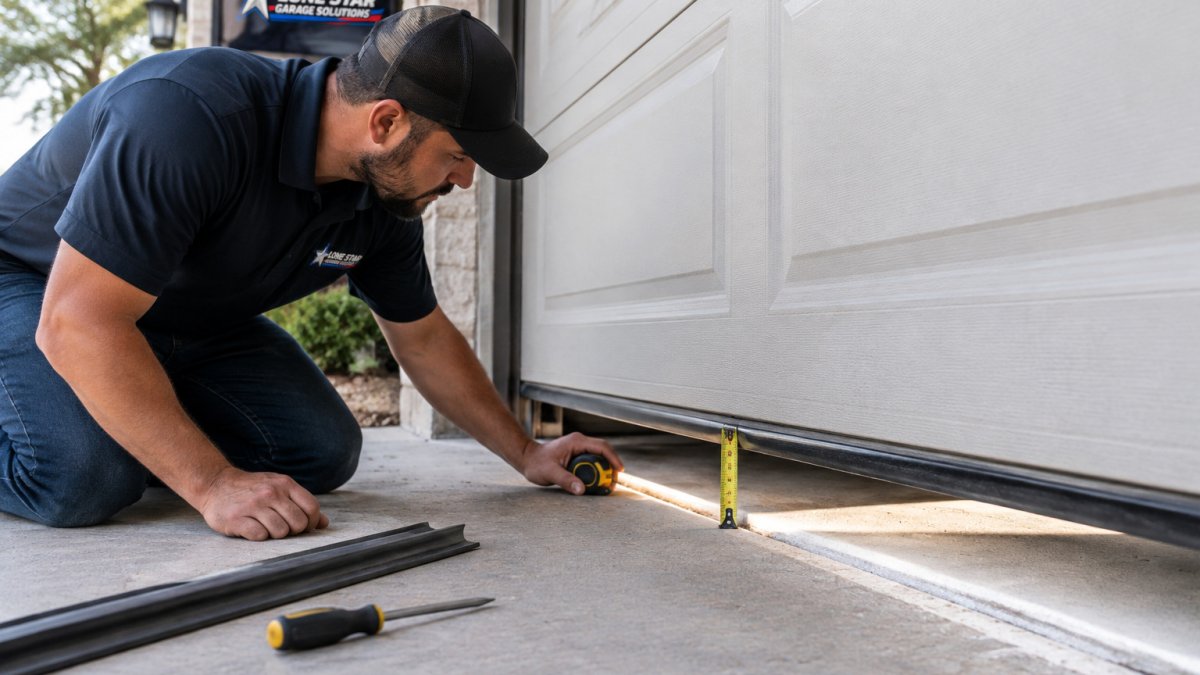
Turn off the garage lights, then go outside on a sunny day and look at the door from the outside. Have someone stand inside with a flashlight and move it slowly along the bottom edge. Any light you see is a leak you can measure.
- Mark each spot with painter's tape.
- Measure the width of the gap at its widest point.
- Note whether the gap is constant or changes from one end to the other.
Tell a seal problem from a floor or opener problem
A seal problem shows up as a gap that is even across the bottom and feels soft or cracked when you touch it. A floor problem shows up as a gap that is bigger at one end. An opener problem shows up when the door closes but stops too high and never touches the floor.
- Seal problem: rubber is cracked, flattened, or pulling away from the door.
- Floor problem: gap is wider on one side, and the concrete slopes or dips.
- Opener problem: door reverses or stops before reaching the floor.
If you suspect the opener, do not adjust it yet. The safety section below explains why.
Fix an Uneven Gap at Bottom of Garage Door Caused by the Floor
Concrete slabs can settle, slope toward the driveway for drainage, or crack and chip over time. When the floor under the door is not flat, a straight bottom seal may not close the gap on its own.
Start by mapping the gap instead of guessing. Close the door, turn off the lights, and have someone inside run a flashlight slowly along the bottom edge while you stand outside. Mark each leak with painter's tape.
Once you know the gap varies, you have three realistic paths. Compare them before you spend money:
- Flexible or oversized bottom seal. Some seal profiles are taller or softer and can conform to a mild slope or dip. This works when the variation is small, roughly under 1/2 inch across the door. It is the least expensive option and the easiest to install yourself.
- Threshold seal on the floor. A threshold strip mounts to the concrete under the door and bridges the space the door cannot reach. It handles larger dips and also helps with water and pests. It is the best fit when the gap is moderate and fairly consistent in one area.
- Floor repair. Small cracks and chips can be filled with concrete patch. A large dip, a broken slab edge, or a floor that slopes steeply may need a contractor to grind, level, or replace sections. This is the most involved and costly route, but it is the only real fix when the concrete itself is the problem.
Measure the high and low points with a level and a straightedge laid across the floor under the door. That reading tells you which path fits. If the variation is small, a flexible seal or a threshold will usually do.
Watch out: Replacing the seal over and over when the real problem is the floor is the most common wasted expense here. If you want a local pro to diagnose the mechanical side, same-day garage door opener repair in New Braunfels, TX is available.
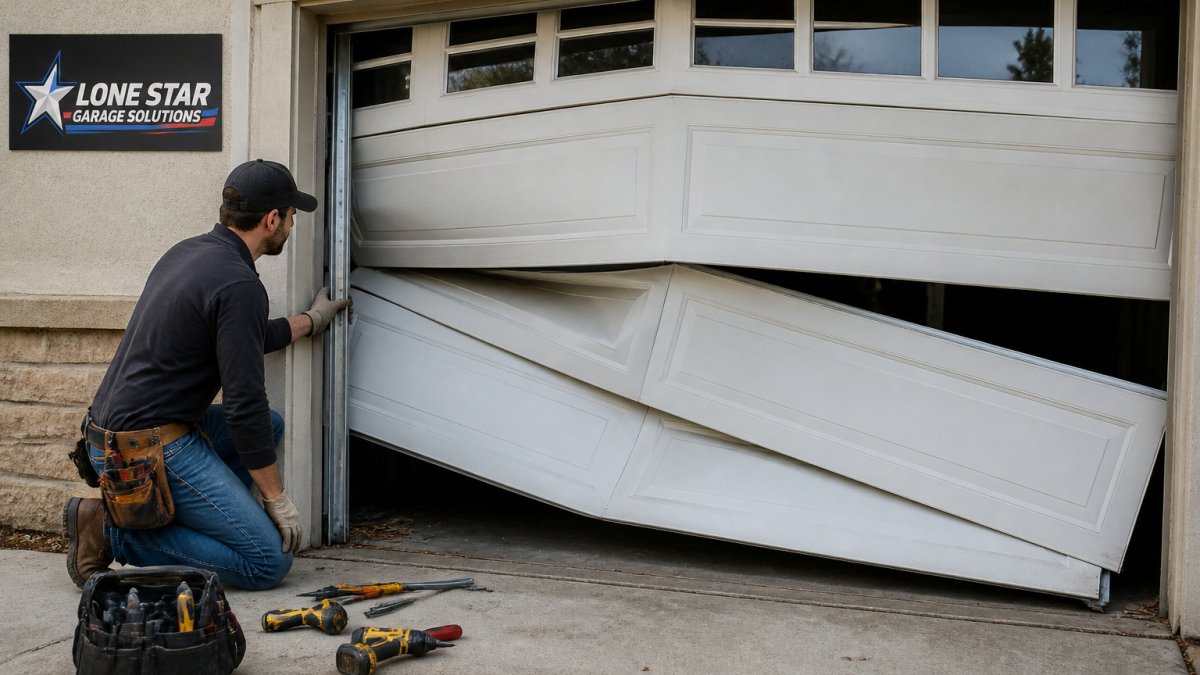
Gaps that vary across the door are also a sign to look at the tracks and hinges, not just the floor. A bent track or a worn hinge can tilt the door slightly and open a corner gap even on a flat slab.
Garage Door Bottom Seal Replacement, Step by Step
A worn bottom seal is the most common cause of a gap, and it is one of the easiest repairs.
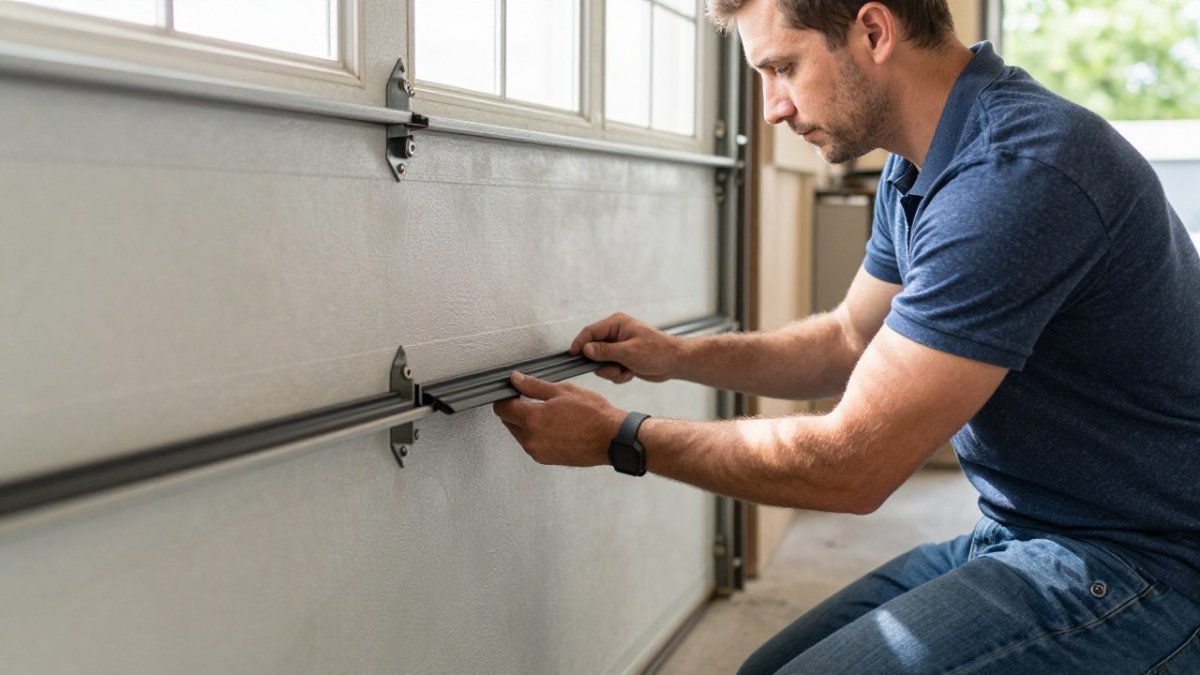
- Time needed: about 1 to 2 hours
- Tools: tape measure, scissors or utility knife, screwdriver, step ladder
- Parts: a replacement bottom seal that matches the width and profile of your door
Follow these steps:
- Close the door and measure. Measure the length of the old seal. Buy a new seal a little longer than you need so you can trim it.
- Remove the old seal. Most bottom seals slide out of a retainer channel on the bottom panel. Unscrew the retainer if needed.
- Clean the channel. Remove dirt and debris so the new seal sits flat.
- Slide in the new seal. Work from one end to the other, pressing it firmly into the channel.
- Trim the ends. Cut the seal so it stops just short of the door edges.
- Test the door. Close it slowly and check for light. Adjust the seal position if needed.
Look for a seal profile that fits your door. Bottom seals come in different shapes and materials, and the wrong one will not seal well. Our guide to Best Garage Door Weather Stripping Options for 2026 compares seal types, materials, and fit so you can choose the right one before buying.
The table below sums up the steps for replacing a worn bottom seal.
| Step | What to do | Time or frequency |
|---|---|---|
| Close the door and measure | Measure the old seal and buy a slightly longer new one | Before buying parts |
| Remove the old seal | Slide it out of the retainer channel; unscrew retainer if needed | As needed |
| Clean the channel | Remove dirt and debris so the new seal sits flat | Before installing |
| Slide in the new seal | Work from one end to the other, pressing firmly | During install |
| Trim the ends | Cut so the seal stops just short of the door edges | During install |
| Test the door | Close slowly and check for light; adjust if needed | After install |
| Total job | Basic tools and a matching replacement seal | About 1 to 2 hours |
Garage Door Travel Limit Adjustment and Safety Warnings
If the door stops above the floor, the travel limit on your opener may be set too high. This adjustment changes how far the door travels before it stops. It is simple in theory, but it involves moving parts that can cause serious injury.
Watch out: Never adjust travel limits with the door open and unsupported. Disconnect the opener first, and keep hands and fingers away from the springs and cables. Springs store enough energy to cause serious injury.
Here is the general process. Check your opener manual for the exact steps:
- Find the limit adjustment screws on the opener.
- Turn the screw slowly to lower the close position.
- Run the door through a full cycle and check for light.
- Stop if the door reverses or binds.
If the door has a spring problem, adjusting travel limits will not fix it, and it can make things worse. Unbalanced doors and worn springs need professional attention. Lone Star Garage Solutions offers Garage Door Spring Repair in New Braunfels, TX.
Garage Door Threshold Seal and Water Intrusion
A threshold seal is a strip that mounts to the floor under the door, not to the door itself.
Threshold products come in a few common forms. For a closer look at sealing gaps against pests and weather, see how to seal garage door gaps against Texas pests.
Installation is straightforward but fussy. Clean and dry the concrete thoroughly, because adhesive will not bond to dust or damp slabs.
Watch out: A threshold seal cannot stop water that flows across the floor from a steep driveway, and it will not fix a garage that drains toward the house.
That distinction matters. Water intrusion has three common sources: gaps at the door, water running across the slab from uphill, and poor drainage around the foundation. A threshold addresses only the first.
Climate also affects how long seals last. Heat, sun, and humidity break down rubber faster than in cooler regions, so check the bottom seal and threshold each season and replace them when they crack, flatten, or pull loose.
Booking a Gap Repair With Lone Star Garage Solutions
If you have worked through the steps above and the gap is still there, or if the door is unbalanced, damaged, or the opener needs professional adjustment, it is time to call a pro. A local garage door professional can diagnose the cause on site and recommend the right repair for your door.
We serve New Braunfels and nearby Central Texas communities, and we can help with seals, floors, springs, and openers. If the repair costs more than you want to pay at once, you can explore garage door financing in New Braunfels, TX. Financing is available on qualifying projects.
Contact Lone Star Garage Solutions today for a quote on your gap repair.
Frequently Asked Questions
How can I fix the gap at the bottom of my garage door?
Start by finding where light comes through when the door is closed. If the gap is caused by a worn bottom seal, replacing the seal usually closes it. Measure the seal before ordering, since weatherstripping comes in several profiles that do not fit every door. If the floor slopes or the door sits unevenly, the seal alone may not close the gap, and the door may need adjustment or professional inspection.
How do I adjust a garage door opener to close the bottom gap?
The opener's travel limit settings control how far the door closes. Adjusting them can change how firmly the door meets the floor, but it is not a fix for a worn seal or uneven concrete. Work carefully, keep the door in view, and stop if the door binds or reverses unexpectedly. Never force the door to close further than its safety reversal allows, because the auto-reverse feature protects people and pets.
Why is there a gap under my garage door?
Most gaps come from a worn or compressed bottom seal, a threshold that has shifted, or a floor that is uneven or sloped. Gaps often vary across the width of the door because the floor is not level. Checking each section with the door closed and the light off shows whether the gap is isolated or spread across the whole bottom edge.
When should I call a professional about a garage door gap?
Call a professional if the door is hard to close, makes grinding or popping noises, reverses for no clear reason, or if the gap is large and does not close after replacing the seal. Lone Star Garage Solutions in New Braunfels can inspect the door, seal, opener settings, and floor condition and give you a quote for the repair.