 comparison
Belt Drive vs Smart Garage Door Opener for Your Home
Quick Summary
Belt drive describes how the opener moves the door, while smart describes what it can do with your phone and home network. A belt drive opener can be smart, and a smart opener can use a chain. Belt drives run quieter because rubber absorbs vibration, so they are usually the better pick for homes with a bedroom near the garage.
- Belt drive versus chain drive is a question about noise, upkeep, and lifting power.
- Belt drives run quieter because rubber absorbs vibration and needs less lubrication.
- Chain drives usually cost less at purchase and handle heavy doors well.
- Smart features cover remote access, alerts, and app control, independent of drive type.
- A standard opener without battery backup stops during a power cut, so know your manual release.
Table of Contents
- Belt Drive and Smart Opener Are Not the Same Choice
- How Belt Drive and Chain Drive Openers Work
- Smart Garage Door Opener Features Explained
- Garage Door Opener Noise: What to Expect
- Belt Drive vs Smart Opener Pros and Cons
- Total Cost of Ownership and Maintenance
- Choosing Your Opener and Booking a Quote in New Braunfels
- Frequently Asked Questions
Belt Drive and Smart Opener Are Not the Same Choice
Many homeowners assume a belt drive and a smart opener are the same decision. They are not. Belt drive describes how the opener moves the door; smart describes what it can do with your phone and home network.
The belt versus chain question is about noise, upkeep, and lifting power. The smart question is about remote access, alerts, and connectivity. Mixing them up means paying for features you do not need or missing ones you do.
How Belt Drive and Chain Drive Openers Work
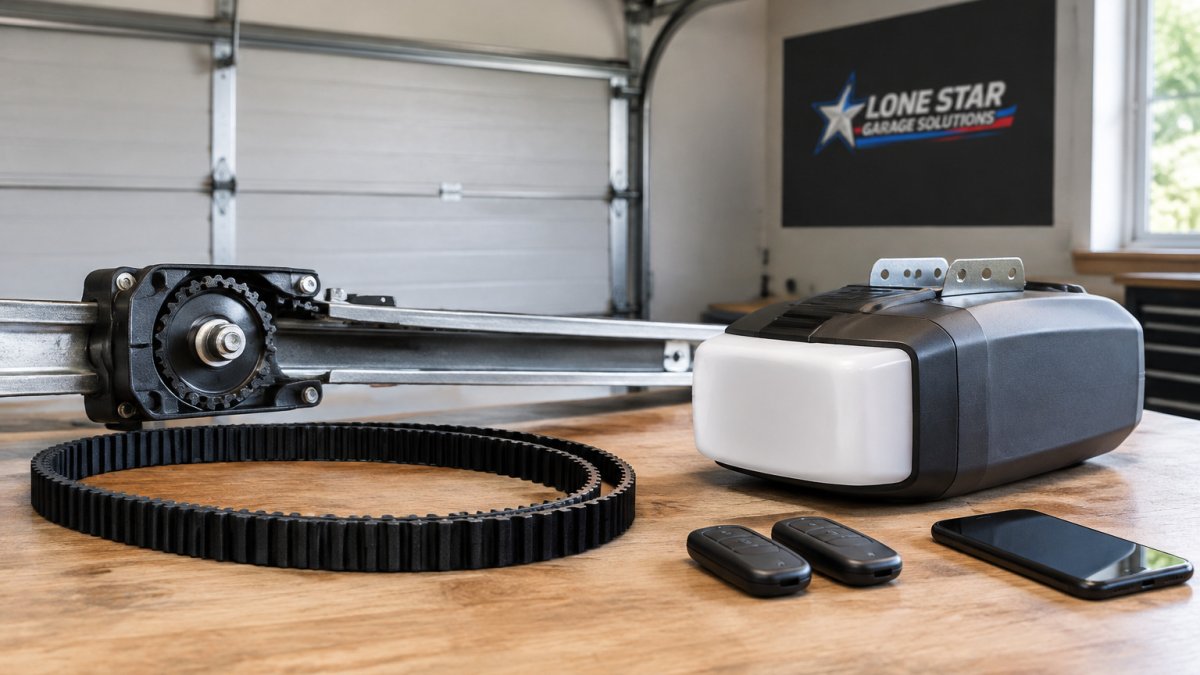
A garage door opener uses a motor to push or pull a trolley that runs along a rail.
Chain drives are the older, more common design. They tend to cost less at purchase and handle heavy doors well. The trade-off is noise.
Belt drives run quieter because rubber absorbs vibration. They also need less lubrication, since there is no metal-on-metal contact.
Smart Garage Door Opener Features Explained
A smart opener adds connectivity to the motor, but "smart" covers a wide range of capabilities, and two openers can both be called smart and behave very differently. Separate the drive type (belt or chain) from the smart layer, because they are independent choices. The smart layer is what you interact with through an app, a voice assistant, or an automation routine.
Many smart openers connect over Wi-Fi and pair with a smartphone app. Common capabilities include:
- Remote open and close from anywhere you have a signal
- Push alerts when the door opens or closes, and sometimes when it stays open past a set time
- Voice control through a compatible home assistant
Compatibility and Retrofit: You May Not Need a New Opener
Smart control does not always require replacing the whole opener.
Before adding smart control to an existing opener, confirm:
- The opener's age and whether replacement parts are still available
- That the door is balanced and the safety reversal system works
- That the safety sensors are aligned and undamaged
Watch out: adding a smart controller to an opener that is already failing or out of balance hides the real problem and can leave you with a connected opener that still will not lift the door reliably.
Security and Account Protection
A connected opener is only as secure as the account and network that control it. Most manufacturers document basic account protections, and the practical steps are consistent across brands:
- Use a unique, strong password rather than reusing one from another service
- Turn on two-factor authentication where the app offers it
- Review the user list periodically and remove anyone who no longer needs access
Access sharing is convenient but deserves a second look. Temporary access for a house sitter, contractor, or delivery is useful, but confirm how revocation works and whether the app keeps an activity log. If an account is compromised, the first signs are usually unexpected open or close events in the activity history, so check that log after any suspicious alert.
Power and Internet Outages
Smart features depend on two separate systems: power at the opener and internet at the router. They fail independently, and it helps to know which functions survive each.
- Power outage at the home: A standard opener without battery backup stops. You use the manual release to disengage the trolley and lift the door by hand. A model with battery backup can open the door for a limited number of cycles, so confirm the rated cycle count before relying on it.
- Internet outage only: The motor and wall button still work. The app and voice control do not, because they route through the cloud. Local remotes and the wall control remain available.
- Router or Wi-Fi outage: Same as an internet outage for app control. The opener itself is unaffected.
A practical pattern many homeowners adopt is to keep a working remote in the car and a keypad or wall button inside, so the smart layer is a convenience rather than the only way in.
What Smart Does Not Do
Smart features do not change lifting power, noise level, or motor life, which depend on drive type, door balance, and installation. Those come from the drive type, door balance, and installation. If quiet operation is your priority, the belt versus chain decision matters more than the app. If remote monitoring is your priority, the smart layer matters more than the drive.
Garage Door Opener Noise: What to Expect
Noise is a common concern homeowners raise about openers. A belt drive generally runs quieter than a chain drive, and both make some sound at startup and stop.
Ways to reduce noise, whatever type you choose:
- Mount the motor on a sturdy ceiling joist rather than drywall alone
- Keep the rail and trolley lubricated as the manufacturer directs
- Install a rubber or foam pad where the opener meets the ceiling bracket
- Adjust the door balance so the motor is not working against a heavy or sticking door
Belt Drive vs Smart Opener Pros and Cons
Here is how the two choices compare on the points that matter most to homeowners.
| Factor | Belt Drive | Chain Drive | Smart Opener |
|---|---|---|---|
| Noise | Quieter | Louder | Depends on drive type |
| Upfront cost | Usually higher | Usually lower | Usually higher |
| Maintenance | Low | Needs lubrication | Low to moderate |
| Heavy doors | Check lifting rating | Strong fit | Check lifting rating |
| Remote access | Only if smart | Only if smart | Yes |
Belt drive pros: quiet, low maintenance, smooth operation. Belt drive cons: typically costs more and may need a closer check on lifting power for very heavy doors.
Chain drive pros: lower upfront price, strong lifting for heavy doors. Chain drive cons: louder, needs regular lubrication.
Outages, Security, and Compatibility
Power and internet outages affect each opener differently. A standard opener without battery backup stops during a power cut, so you need the manual release to open the door by hand.
Compatibility matters for retrofit installs. Check that the opener matches your door weight, track type, and ceiling clearance. Older Texas garages often have mismatched parts from earlier repairs, so an inspection before purchase prevents surprises.
Total Cost of Ownership and Maintenance
Purchase price is only part of what an opener costs over its life. Comparing two models on sticker price alone often points you to the wrong one, because installation, maintenance, parts, and connected-feature terms can shift the total.
Purchase and Installation
Opener pricing depends on factors such as drive type, lifting rating, smart features, and the condition of your existing door and track. For current pricing, request a quote from Lone Star Garage Solutions. Installation labor varies with ceiling height, mounting condition, whether the old opener and rail need removal, and whether the door needs balancing or sensor work first. A belt drive typically costs more at purchase than a comparable chain drive, and a smart model typically costs more than a non-smart model of the same drive.
Maintenance
Maintenance is the smallest recurring cost but the one most often skipped. Chain drives need periodic lubrication along the chain and rail. Belt drives need less lubrication but still benefit from an annual check of belt tension, the trolley, the safety reversal system, and the safety sensors. An unbalanced door makes the motor work harder and shortens the life of any opener, so a simple annual inspection catches most issues before they become repairs.
Repairs and Replacement Parts
Worn trolleys, drifting limit settings, remote and keypad batteries, safety sensors, and gear assemblies are the most common fixes. Keeping a service record helps you spot patterns, such as a trolley that wears out repeatedly because the door is out of balance. When an opener is older and parts become hard to source, repair cost can approach replacement cost, so compare rather than assume repair is always cheaper.
Smart Feature Costs
Some connected features require a subscription on certain models, and some do not. Read the terms before you buy so you know whether app control, activity history, or integrations are included or billed monthly. A smart controller added to an existing opener is often the lower-cost path when the motor is healthy, because you are paying for the smart layer rather than a full replacement.
A Practical Way to Compare
Ask for a written breakdown that separates the opener, installation labor, any door or track work, and the terms of any connected features. Then compare the total over the expected life of the unit, not just the first invoice. A slightly higher upfront cost on a belt drive or a smart model can be the better value if it fits how you actually use the garage.
Choosing Your Opener and Booking a Quote in New Braunfels
Start with three questions: How close is the garage to living space? How heavy is your door? Do you want remote access, or is a wall button and remote enough? If noise matters most, lean belt drive.
Before you buy, review our alternatives to standard garage door openers for the full range of options, from smart controllers to wall-mount and belt-drive systems. If you are ready to compare current picks, our best garage door opener 2026 buying guide covers belt versus chain drive and horsepower needs in detail.
For Texas homes, our belt drive vs smart opener guide for Texas heat and heavy doors addresses the conditions that matter most locally. If your current opener is failing or you need repair first, our garage door repair in New Braunfels homeowner guide explains spring costs, maintenance checklists, and when to call a pro. For new hardware or a full door replacement, see our garage door installation options in New Braunfels, TX, which covers insulated and carriage-style doors and opener pairing.
Lone Star Garage Solutions is a locally owned team serving New Braunfels and nearby Central Texas. Contact us for a quote.
Ready to choose the right opener for your garage? Contact Lone Star Garage Solutions for a quote and a clear recommendation based on your door, your space, and how you use it.
Frequently Asked Questions
What are the downsides of a belt-driven garage door opener?
Belt-drive openers cost more upfront than chain-drive models, and the rubber belt can stretch or wear over time, especially in hot Texas summers, which may require adjustment or replacement. Belts also do not handle extremely heavy doors as well as steel chains, so a heavy or oversized door may need a more powerful motor. Checking the opener's rated lifting capacity against your door's weight before buying is the simplest way to avoid problems.
Is it better to get a belt drive or chain drive garage door opener?
A belt drive is usually the better choice when quiet operation matters, especially if the garage is attached to living space or a bedroom sits nearby. A chain drive tends to be the more budget-friendly option and handles heavy doors well, but it runs louder. The right answer depends on how the garage is used, how heavy the door is, and how much noise your household can tolerate.
Can a belt-drive garage door opener also be smart?
Yes. The drive system and smart features are separate choices. Some belt-drive models include Wi-Fi connectivity, a smartphone app, remote access, and real-time alerts, while other belt-drive openers are standard models with no app support. When comparing products, confirm the drive type and the smart features separately, and check the app, compatibility, and warranty details listed by the manufacturer.
Can I add smart features to my existing garage door opener?
In many cases, yes, but it depends on the opener's age and model. Some older openers can accept a smart add-on or wall control that provides app access, while others need a full replacement to get modern connectivity. Before buying a kit, check your opener's make and model, confirm compatibility, and ask a professional to inspect the existing system. Contact Lone Star Garage Solutions for a quote.