
 listicle
Best Garage Door Opener for Texas: 2026 Buyer's Guide
Table of Contents
- How Texas Heat, Storms, and Power Outages Shape Your Opener Choice
- Belt Drive vs Chain Drive Garage Door Opener: Which Fits Your Home
- Smart Garage Door Opener Features Worth Paying For
- Top Garage Door Openers for 2026: Model Comparison
- Garage Door Opener for Heavy Doors: Matching Horsepower to Door Weight
- Garage Door Opener Cold Weather Problems (and the Texas Cold Snaps That Cause Them)
- Compatibility Checks Before You Buy
- Conclusion: Getting the Right Opener Installed Right
- Frequently Asked Questions
Last Updated: October 4, 2026
How Texas Heat, Storms, and Power Outages Shape Your Opener Choice
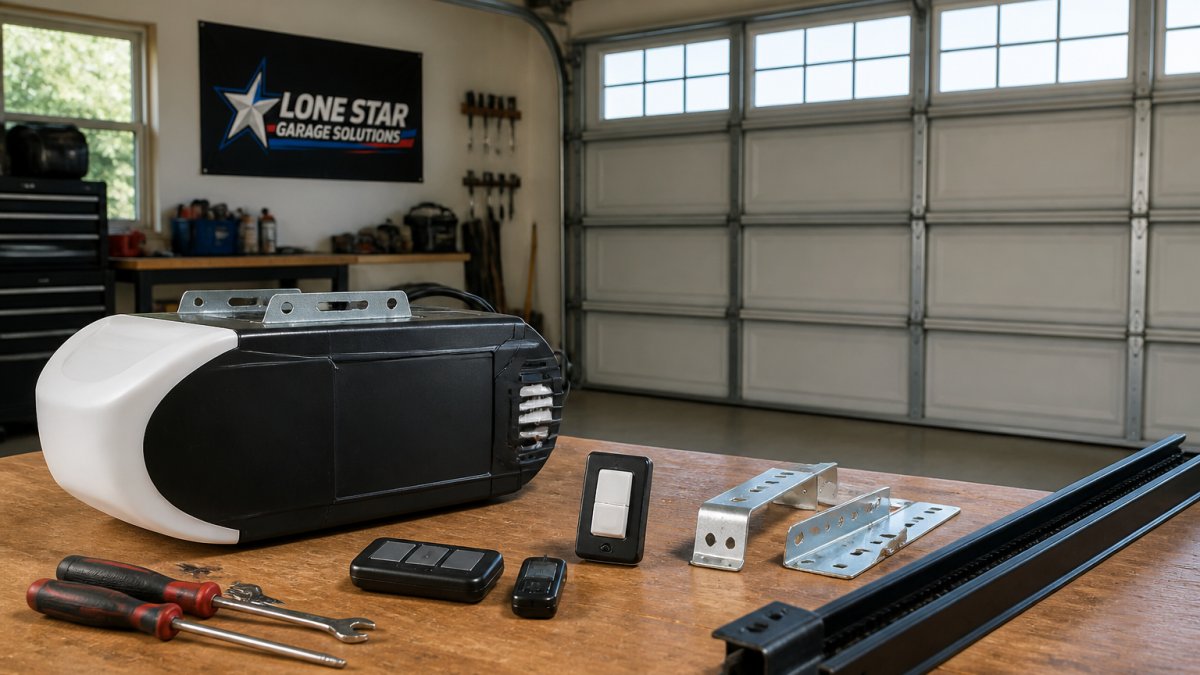
The best garage door opener for Texas survives heat, humidity, and storms that knock out power for a day. We see the same failures across New Braunfels and the Hill Country: cracked belts, boards cooked by attic heat, and doors that won't budge when the grid goes down.
What Breaks First in a Central Texas Garage
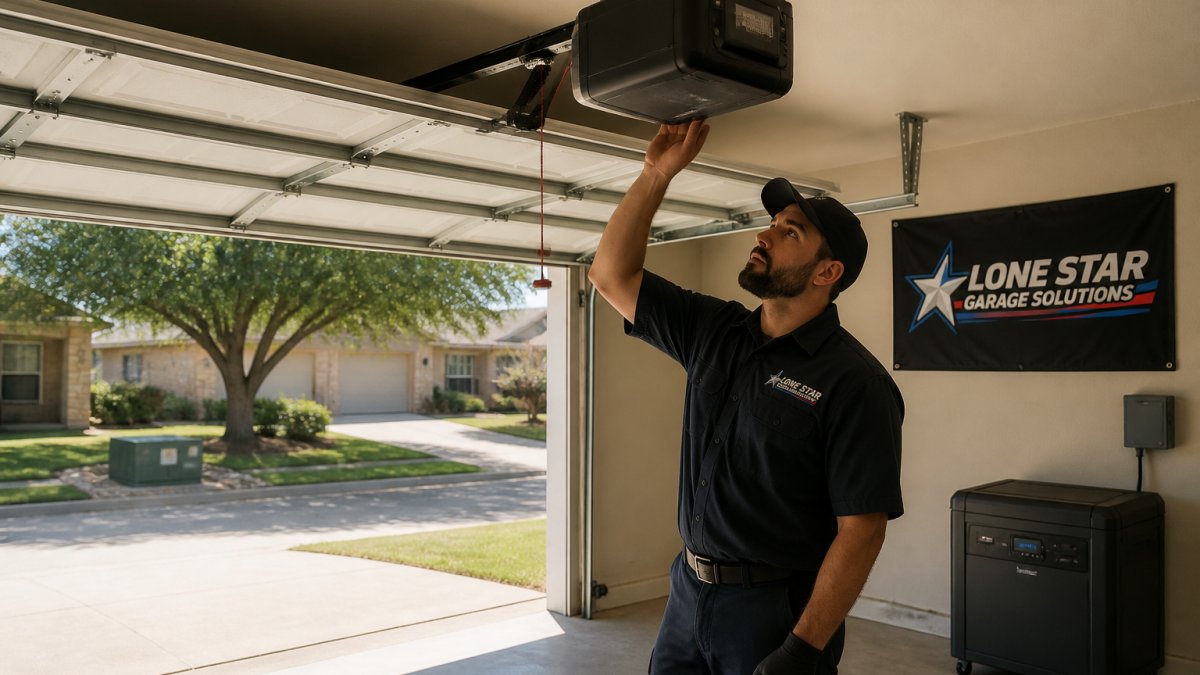
Heat is the biggest killer of openers here. An unconditioned garage bakes for hours, shortening the life of belts, logic boards, and lubricants. Humidity corrodes chains and stiffens rollers until the motor works harder than it should. Storms add surges that fry control boards and outages that leave you pulling a release cord in the dark.
Belt Drive vs Chain Drive Garage Door Opener: Which Fits Your Home
Belt drive is quieter and fits most attached garages, especially with a bedroom nearby, the rubber belt absorbs vibration into a soft hum. Chain drive costs less up front and handles heavy doors well, but it's louder and needs occasional lubrication.
| Drive Type | Noise Level | Maintenance | Best For |
|---|---|---|---|
| Belt drive | Quietest | Low | Attached garages, bedrooms nearby |
| Chain drive | Loudest | Lubricate chain | Detached garages, tight budgets |
| Screw drive | Moderate | Low | Steady year-round use |
| Direct drive | Very quiet | Low | Homeowners wanting minimal upkeep |
If noise is your main complaint, belt drive is the simplest fix. If durability under heavy use matters more, chain or screw drive serves for years with basic care.
Smart Garage Door Opener Features Worth Paying For
A smart garage door opener connects to your home Wi-Fi so you can open, close, and monitor the door from a phone. The features worth paying for are the ones you'll use: remote access, real-time open/closed status, and alerts when the door runs. Rolling-code security matters too, older fixed-code remotes can be copied, while rolling-code systems generate a new code with every use.
- Wi-Fi and app control: check or close the door from anywhere
- Battery backup: keeps the door working when power fails
- Rolling-code remotes: stronger protection against code grabbing
Top Garage Door Openers for 2026: Model Comparison
Most 2026 roundups rank openers on loose labels, "best overall," "quietest," "best value", without showing how models were scored. That's hard to use when your garage is a hot, unconditioned Central Texas space with a heavy insulated door. Here's the scorecard we apply in the field, and how common 2026 roundup picks map onto it.
The Scorecard We Use
Every opener gets judged on the same six criteria, in this order for a Texas garage:
- Lifting capacity vs. door weight, measured against the actual door, not the size class.
- Drive type and noise, belt, chain, screw, direct, or wall-mount, matched to whether a bedroom sits above the garage.
- Battery backup, built in or add-on, and whether the battery is user-replaceable.
- Smart features, Wi-Fi/app control, real-time open/closed status, rolling-code remotes, smart-home compatibility.
- Warranty terms, motor, parts, and belt/rail coverage often differ; read all three.
- Serviceability and parts availability, how fast a local technician can get a logic board, belt, or gear kit, and whether the model is still supported.
How the Common 2026 Roundup Picks Map to the Scorecard
LiftMaster 87504-267 Secure View, A wall-mount model a 2026 roundup named best overall.
Chamberlain B2405, A belt-drive opener with myQ features, listed as a top seller in a 2026 roundup.
Genie Chain Drive 500, A best-value pick in a 2026 roundup.
LiftMaster 8550W, Named best overall in a 2026 roundup.
Genie SilentMax Connect, Called the quietest model in a 2026 roundup.
Chamberlain C450, A budget pick in a 2026 roundup.
LiftMaster 8500W, A wall-mount option from a 2026 roundup of four models.
LiftMaster 87802, Described as heavy-duty in a 2026 roundup.
Quick Comparison Table
| Model | Drive Type | Smart Features | Best For |
|---|---|---|---|
| Lone Star Garage Solutions | Matched to your door | Yes, set up for you | Most Texas homes |
| LiftMaster 87504-267 | Wall mount | myQ Wi-Fi | Quiet, connected wall mount |
| Chamberlain B6753T | Not stated | Smart | Best-overall smart pick |
| Chamberlain B2405 | Belt | myQ | Quieter attached garages |
| Genie Chain Drive 500 | Chain | Not stated | Budget, detached garages |
| Genie SilentMax Connect | Not stated | Not stated | Quiet operation |
| LiftMaster 87802 | Not stated | Not stated | Heavy-duty needs |
Battery Backup and Power Outage Performance
Battery backup keeps your opener running when the power drops, and in Central Texas that's not a luxury. A backup unit typically opens and closes the door a limited number of times on battery, enough to get vehicles in or out during an outage, not to run the door all day. Check whether backup is built in or sold separately, and confirm the battery is user-replaceable so you're not stuck when it ages out.
What the Roundups Don't Tell You
Two things matter more than any spec sheet: whether the opener is sized to your actual door, and whether the model is still serviceable in five years. A discontinued model or one with a long parts lead time can leave you waiting on a repair. When we quote an opener, we weigh the door, check spring balance, confirm clearance, and pick a model we can service locally.
Garage Door Opener for Heavy Doors: Matching Horsepower to Door Weight
A garage door opener for heavy doors needs its lifting capacity matched to the door's actual weight, not guessed from its width. Wood and insulated doors weigh far more than a basic single-car steel door, and an undersized motor strains, stalls, or wears out early. Horsepower is only part of the picture; drive type and door balance matter just as much.
Why Weight, Not Size, Is the Number That Matters
Two doors the same width can differ by hundreds of pounds depending on material and insulation. A rough field guide:
- Single-car steel, uninsulated: the lightest class; a standard-duty opener is usually enough.
- Single-car steel, insulated: noticeably heavier; step up to a mid-range unit.
- Double-car steel, insulated: heavier still; match lifting capacity with headroom.
Weigh the door, then choose an opener rated above that figure with headroom to spare, since the opener also fights friction from rollers, hinges, and weather seals, especially in a humid garage where rollers stiffen.
The Springs Do the Lifting, the Opener Only Guides
This is the part most buyers miss. A torsion or extension spring system counterbalances the door so it feels nearly weightless by hand.
If the springs are worn, the opener carries weight it was never designed to carry. It strains, reverses, or burns out early, and a bigger motor won't fix it. Fix the balance first, then size the opener.
Horsepower, Drive Type, and the Heavy-Door Trade-off
Horsepower ratings are a rough proxy, not the whole story. Chain or screw drive handles heavy doors well and tolerates the extra resistance of a stiff, humid garage. Belt drive is quieter, but the belt is a wear item under heavy load. Wall-mount (jackshaft) openers pair well with torsion-spring doors and free up ceiling space, but need the right torsion setup and a nearby outlet.
- Single-car steel door: lighter, standard-duty opener
- Double-car steel door: mid-range lifting capacity
- Insulated or wood door: higher capacity, often heavy-duty rated
Compatibility Checks Before You Buy a Heavy-Door Opener
Before buying, confirm the drive type fits your ceiling or wall layout, the rail length matches your door height, and the opener's lifting capacity exceeds your door weight. Check whether your existing remotes, keypad, and safety sensors will work with the new unit, since mixing brands often means replacing accessories too.
If your garage has a low ceiling, a wall-mount opener may be the only clean fit. If you have a smart-home system, verify the opener supports it rather than assuming. U.S.
- Measure door height and weight before shopping
- Confirm ceiling or wall clearance for the drive type
- Check lifting capacity against door weight
When a Heavy Door Needs More Than a New Opener
Sometimes the right answer isn't a bigger motor. If the door is out of balance, the springs are undersized, or the track is misaligned, a new opener inherits the same problem. Fix spring, cable, or track work first, then size an opener to the corrected door.
Garage Door Opener Cold Weather Problems (and the Texas Cold Snaps That Cause Them)
Cold snaps cause garage door opener cold weather problems even in Texas. When temperatures drop, lubricants thicken, metal contracts, and a door that ran smoothly in summer suddenly feels stiff.
The usual culprits are stiff rollers, hardened grease on the rail, and a door slightly out of balance. A cold snap doesn't create these problems, it exposes them. If your door only acts up in a freeze, the fix is usually maintenance, not a new opener.
Before you replace anything after a cold snap, lubricate the rollers, hinges, and rail, then test the door by hand with the opener disconnected. If it moves freely, the opener was never the problem.
Compatibility Checks Before You Buy
If your garage has a low ceiling, a wall-mount opener may be the only clean fit. If you have a smart-home system, verify the opener supports it rather than assuming. U.S. Department of Energy guidance on home energy and garage efficiency is a useful reference if you're also weighing insulation upgrades alongside the opener.
- Measure door height and weight before shopping
- Confirm ceiling or wall clearance for the drive type
- Check lifting capacity against door weight
Conclusion: Getting the Right Opener Installed Right
Choosing an opener in Texas means planning for heat, storms, and the occasional freeze, not just picking the quietest box on the shelf. Get the drive type, lifting capacity, and backup power right, and the opener serves you for years.
That's where we come in. Lone Star Garage Solutions installs and services openers across New Braunfels and the surrounding Hill Country, with same-day repair service, flexible financing on qualifying projects, and recommendations built around the Texas climate instead of a national average.
Frequently Asked Questions
Are belt-drive garage door openers quieter than chain-drive models?
Yes. Belt drives use a rubber belt instead of a metal chain, which removes most of the rattle you hear from a chain drive. That matters if a bedroom or living space sits above or beside the garage. The tradeoff is price: belt-drive units usually cost more than chain drives, and the belt can stretch over time. For most attached garages, the noise reduction is worth it.
Do smart garage door openers work during a power outage?
Only if they have a battery backup. A smart opener with Wi-Fi and smartphone control still needs power to run the motor, so when the grid goes down the app goes dark. Models with an integrated battery backup keep the opener working for a limited number of open and close cycles. For Texas storm season, that backup is the feature that actually matters.
Why doesn't my garage door opener work in cold weather?
Cold weather thickens the lubricant in the rails and rollers, and metal contracts slightly, so the door drags and the opener strains. A door that is already out of balance makes it worse. The opener's safety sensors can also fog or frost over. If your opener struggles every winter, the door likely needs lubrication, balance adjustment, or a service call before the next cold snap.
How much horsepower does a garage door opener need?
The horsepower needed depends on the door's weight and type. A properly balanced door reduces the load on any motor, so have the door checked before blaming the opener. Horsepower is not the only factor: a properly balanced door reduces the load on any motor, so have the door checked before blaming the opener.
How often should a garage door opener be replaced?
Most openers last 10 to 15 years with regular maintenance. Replace it sooner if the motor is loud, the door reverses for no reason, the remote range has shrunk, or repair estimates start approaching the cost of a new unit. If your opener is older than a decade and you are already paying for a repair, a replacement is usually the better long-term call.