
 ultimate-guide
Garage Door Repair New Braunfels: 2026 Homeowner Guide
Table of Contents
- Why Garage Door Repair in New Braunfels Is Different
- Most Common Garage Door Repairs We See
- Garage Door Spring Replacement Cost: What Affects the Price
- Your Garage Door Maintenance Checklist for Texas Weather
- Garage Door Opener Troubleshooting: Fixes You Can Try First
- When to Call a Professional vs. DIY
- Emergency Repair and Same-Day Service
- Frequently Asked Questions
Last Updated: September 17, 2026
Why Garage Door Repair in New Braunfels Is Different
Garage door repair in New Braunfels is shaped by a climate that punishes hardware year-round. The combination of intense heat, high humidity, and expansive clay soil accelerates wear on springs, cables, and tracks in ways that homeowners in milder regions rarely experience. At Lone Star Garage Solutions, we see the same failure patterns repeat across Hill Country neighborhoods, and they almost always trace back to environmental stress rather than manufacturing defects.
Heat, Humidity, and Hill Country Soil
Thermal expansion is the primary culprit. Garage doors and their metal components expand in triple-digit summer heat, then contract sharply when evening temperatures drop. That constant cycle loosens fasteners, warps panels, and fatigues torsion springs faster than their rated lifespan suggests.
Humidity compounds the problem. Moisture in the air corrodes cables and rollers, while the region's expansive clay soil shifts with every wet-dry cycle. When the slab beneath your garage moves, the door frame racks out of square, and that misalignment puts uneven stress on every moving part.
U.S. Department of Energy guidance on extreme heat and home durability
Most Common Garage Door Repairs We See
The most frequent repairs in this region fall into two categories: mechanical failures involving springs, cables, and tracks, and electrical failures involving openers and safety sensors. Mechanical issues tend to appear first, because they're driven by physical wear that heat and humidity accelerate.
Broken Springs, Cables, and Bent Tracks
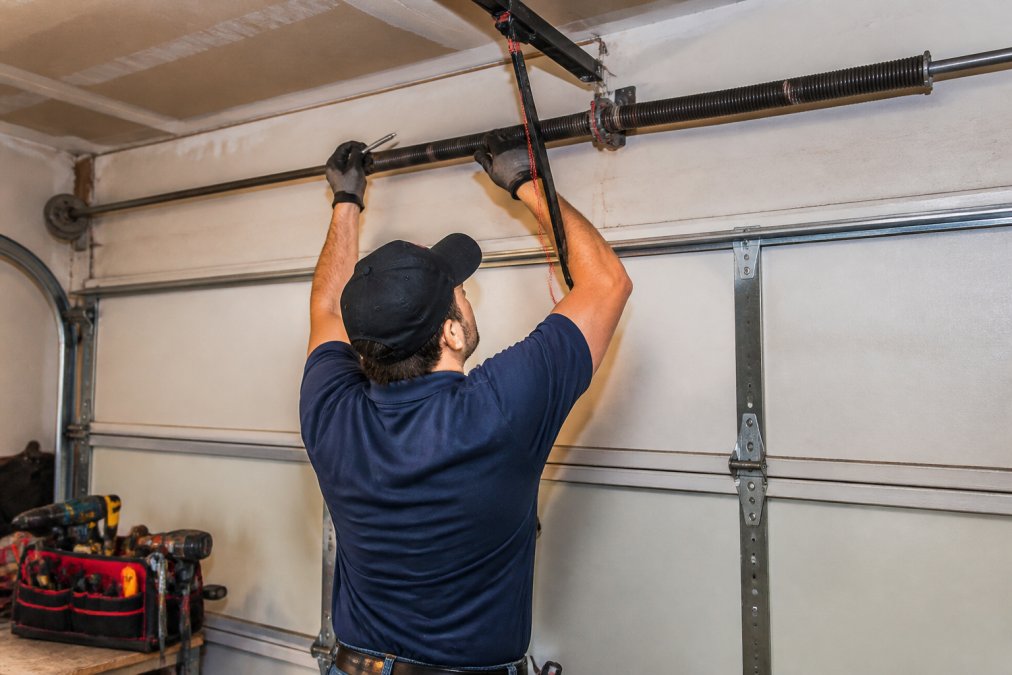
Torsion springs and extension springs carry the full weight of the door, and they're the parts most likely to fail first. A broken spring usually announces itself with a loud bang, followed by a door that won't open or feels impossibly heavy.
Cables fray and snap when corrosion weakens the strands. Bent tracks almost always follow a cable failure or an impact, and once a track bends, the door can come off-track entirely. Roller replacement and door balance checks are the fixes that keep these failures from cascading.
Opener and Sensor Failures
Opener problems often start small. A wall button that works intermittently, a remote that needs re-pairing, or a gear and sprocket that grinds instead of lifting smoothly all point to internal wear. Sensor alignment is another common culprit: if the safety reversal system's photo-eye lenses are knocked out of line or clouded with dust, the door refuses to close.
Garage Door Spring Replacement Cost: What Affects the Price
Most pages on this topic either hide behind "call for a quote" or paste a single national average that has nothing to do with your door. Here's the honest version: spring replacement is priced by the job, not by the spring, and the variables below are what move the number up or down.
The Cost Drivers, In Order of Impact
Spring type. Torsion springs mount on a shaft above the door and do the lifting through torque. Extension springs stretch along the horizontal tracks on each side. Torsion conversions and replacements generally cost more because they involve a wound shaft, drums, and cables under load, while extension springs are simpler to swap but stretch the door's hardware differently over time.
Door weight and height. A single-car door and a double-car door do not use the same spring. Springs are rated by wire gauge, inside diameter, and length, and a heavier insulated door needs a higher-cycle spring.
What a Written Estimate Should Show
A reputable estimate itemizes the spring type and cycle rating, the number of springs, any cables or drums being replaced, labor, and the warranty on parts and workmanship. If a quote is a single number with no breakdown, ask what's included, and ask whether the price changes if a second spring or a cable is added mid-job.
Why Phone Quotes Are a Red Flag
A technician who quotes a spring replacement over the phone without seeing the door is guessing at wire gauge, door weight, and cable condition. The number that comes back on-site is often higher, and that's how homeowners end up feeling bait-and-switched. A free on-site inspection with a written quote before work starts is the standard to hold any provider to.
Consumer guidance on home improvement contracts and estimates
Your Garage Door Maintenance Checklist for Texas Weather
A garage door maintenance checklist built for this climate looks different from a generic one. Heat, dust, and humidity demand more frequent attention to lubrication, balance, and hardware tightness. The goal is simple: catch wear before it becomes a breakdown.
Monthly and Seasonal Tasks
- Test the safety reversal system by placing an object in the door's path
- Inspect cables for fraying, rust, or slack
- Check rollers for flat spots and replace worn ones
- Lubricate springs, hinges, and rollers with a garage-door-specific lubricant
- Tighten all bolts and brackets on the track and hinges
- Clear debris from tracks and wipe them clean
- Check weather stripping for cracks and gaps
- Listen for new noises during open and close cycles
Preventative maintenance is cheaper than emergency repair, and it extends the life of every component. Schedule a professional safety inspection once a year, ideally before summer heat peaks.
OSHA guidance on garage door and overhead door safety
Garage Door Opener Troubleshooting: Fixes You Can Try First
Most opener problems fall into three buckets: power, signal, or mechanical. Working through them in that order saves you from replacing a remote when the real issue is a stripped gear. Here's how to isolate the failure before you call anyone.
Step 1: Rule Out Power
Check the outlet the opener is plugged into, many are on a dedicated circuit or a GFCI that can trip. If the opener's light doesn't come on and the wall button does nothing, test the outlet with a lamp or phone charger. If the outlet works but the opener is dead, the issue is inside the unit.
Step 2: Isolate Remote vs. Wall Button
Press the wall-mounted button. If the door moves from the wall but not the remote, the problem is the remote or its signal path, not the opener. If neither works, the opener itself or its logic board is the suspect.
Step 3: Check the Safety Sensors
If the door starts to close and immediately reverses, the photo-eye sensors are the cause. Look at both lenses, one should have a steady indicator light, the other should be lit or blinking depending on the model. A blinking sensor light means the beam is broken or misaligned. Wipe the lenses with a dry cloth, then adjust each sensor until both lights are steady.
Step 4: Listen and Watch the Mechanism
Run the door and pay attention to what you hear and see:
- Grinding or a humming motor with no movement, likely a stripped gear and sprocket or a failed capacitor inside the opener.
- Door moves a few inches and stops, often a travel-limit setting that's drifted, or a binding track.
- Door reverses partway up, usually a force-setting issue or a spring that's lost tension.
- Loud bang followed by a dead door, a broken spring, not an opener problem. Stop running the opener.
Step 5: Know When to Stop
[OSHA guidance on garage door(https://www.lonestargaragesolution.com/faqs.html) and overhead door safety | osha.gov]
When to Call a Professional vs. DIY
Some tasks are safe for a homeowner, and some are genuinely dangerous. Cleaning tracks, replacing remote batteries, lubricating moving parts, and reprogramming a keypad are all reasonable DIY jobs. Anything involving torsion springs, cables under tension, or the door's structural balance belongs to a licensed and insured professional technician.
Emergency Repair and Same-Day Service
A door stuck open or off-track is a security problem, not just an inconvenience. That's why 24/7 availability and same-day service matter for residential and commercial garage door emergencies. When a spring snaps or a cable breaks, you need someone who can respond quickly and get the door secured.
Frequently Asked Questions
How much does it usually cost to repair a garage door?
The cost depends on the problem. A simple fix like sensor alignment or remote programming is on the lower end. Spring replacement, cable repair, or panel replacement costs more because of parts and labor. Torsion springs, door size, and whether you need same-day service all affect the final price. Lone Star Garage Solutions offers free estimates so you know the number before work starts.
What is the most common garage door repair?
Broken torsion springs are the most common repair. A standard spring lasts roughly 10,000 cycles, and Texas heat speeds up wear. Other frequent calls include snapped cables, bent tracks, and opener issues like gear and sprocket failure. If your door feels heavy or won't stay open, a spring is usually the cause.
Is it safe to attempt DIY garage door spring repair?
No. Torsion springs store enough energy to cause serious injury or death if they release unexpectedly. The springs, cables, and bottom brackets are under extreme tension. Only a trained technician with proper tools should replace springs or cables. You can safely handle lubrication, sensor alignment, and remote programming yourself, but leave spring work to a professional.
How often should I schedule professional garage door maintenance?
Schedule a professional tune-up once a year. If your door gets heavy daily use, twice a year is better. A technician will check door balance, lubricate moving parts, inspect cables and rollers, test the safety reversal system, and adjust the opener. Regular maintenance catches small problems before they become emergency repairs.