
 listicle
Cibolo Garage Door Opener Repairs: What to Expect
Table of Contents
- What Cibolo Homeowners Should Expect From a Garage Door Opener Repair
- Signs of a Failing Garage Door Opener You Shouldn't Ignore
- Garage Door Opener Troubleshooting You Can Try Before Calling
- Repair or Replace? How to Decide on an Aging Opener
- Professional Garage Door Maintenance Tips That Prevent Repeat Calls
- How to Choose a Garage Door Opener Repair Company in Central Texas
- Frequently Asked Questions
Last Updated: September 21, 2026
What Cibolo Homeowners Should Expect From a Garage Door Opener Repair
A garage door opener that quits is more than an inconvenience. It locks your car in, leaves the house exposed, and turns a two-minute exit into a project. If you are searching for cibolo garage door opener repairs, this guide from Lone Star Garage Solutions walks through what a real repair visit looks like, how to spot a failing unit early, and when replacement makes more sense than another fix.
Garage door opener repairs cover the diagnosis and correction of faults in the motor, logic board, safety sensors, remote system, and drive mechanism that move your door. Most issues trace back to one of a handful of causes, which is why a competent technician can usually identify the problem within the first few minutes on site.
Same-Day Scheduling and What the Visit Looks Like
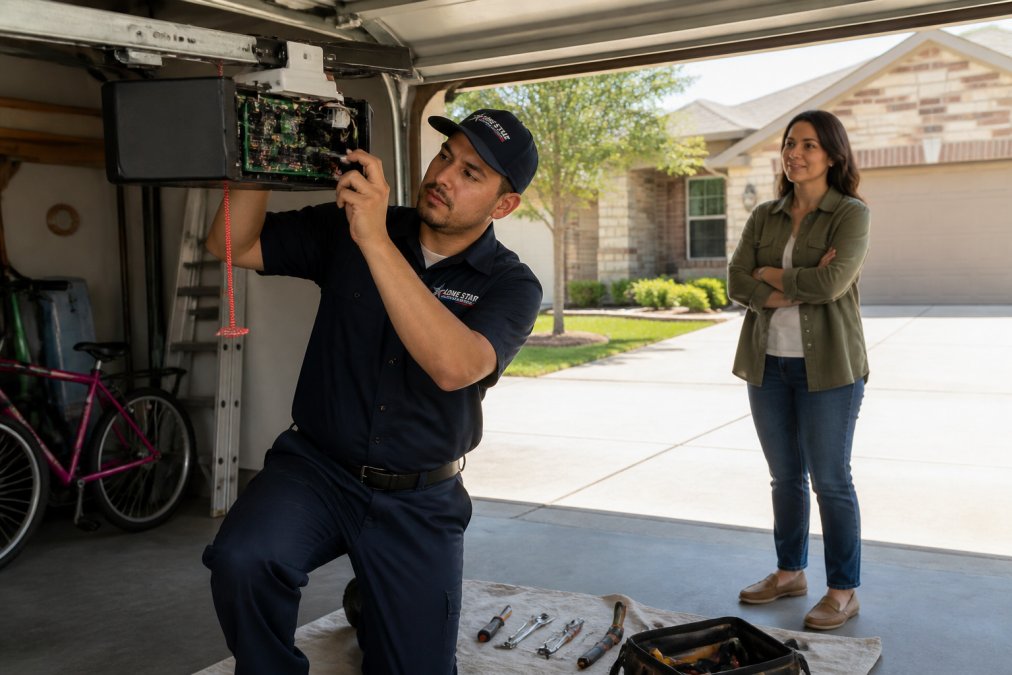
Same-day scheduling means calling in the morning and having a technician at your door that afternoon, not a vague window three days out. A standard visit follows a predictable path:
- The technician tests the wall switch, remotes, and keypad to isolate the fault
- Safety sensors and their alignment get checked first, since they cause the most false failures
- The motor, logic board, and drive system are inspected under load
- You get a clear explanation of the problem and a quote before any work starts
- The repair is completed and the door is cycled several times to confirm it holds
Expect the technician to test the door under real conditions, not just press the button once and call it fixed.
Signs of a Failing Garage Door Opener You Shouldn't Ignore
The clearest signs of a failing garage door opener are inconsistent operation, unusual noise, and a door that reverses for no reason. Catching these early usually means a smaller repair instead of a full replacement.
Watch for these warning signs:
- The door opens partway, then stops or reverses
- Grinding, rattling, or a high-pitched squeal during travel
- The remote works only when you are standing close to the door
- The opener runs but the door does not move
- The lights on the unit flash instead of the door responding
- The motor strains or the housing feels unusually hot after one cycle
A single symptom often points to one cause. Several at once usually means the unit is near the end of its service life. Texas heat is hard on opener motors and logic boards, so units here can wear faster than the national average.
Garage Door Opener Troubleshooting You Can Try Before Calling
Before you call anyone, a few safe checks solve a surprising number of problems. Garage door opener troubleshooting starts with the simplest causes and works outward.
Try these in order:
- Check the power source. Confirm the opener is plugged in and the outlet works. A tripped GFCI outlet is a common culprit.
- Replace the remote battery. A weak battery causes range problems that mimic a failing receiver.
- Inspect the safety sensors. Look for the two small lenses near the floor on each side of the door. If they are misaligned, dusty, or blocked, the door will not close.
- Clear the path. A cobweb, leaf, or parked toy in front of a sensor stops the door every time.
- Test the wall switch. If the wall switch works but the remote does not, the problem is in the remote or receiver, not the motor.
- Look at the manual release. Pull the red cord to disengage the door and test whether it moves freely by hand.
If the door is heavy or hard to lift by hand, stop. That points to a spring or cable problem, not the opener.
When DIY Stops and a Technician Should Start
Stop troubleshooting and call a professional when the door will not stay closed, the opener makes a loud bang, or the door moves unevenly. These point to mechanical failures that can cause injury.
Never attempt to adjust, remove, or replace torsion springs or cables yourself. These parts are under extreme tension and cause serious injuries every year when homeowners try to handle them.
Repair or Replace? How to Decide on an Aging Opener
Repair makes sense when the unit is under about ten years old and the fault is isolated. Replace when the opener is older, needs repeated repairs, or lacks modern safety features.
Use this framework to decide:
| Situation | Recommended Path | Why |
|---|---|---|
| Unit under 10 years, one clear fault | Repair | The motor and drive system still have life |
| Unit over 12-15 years, first major fault | Lean toward replace | Parts availability and reliability decline |
| Same problem returns within a year | Replace | Recurring faults signal a worn unit |
| No safety reversing feature | Replace | Modern openers include this as standard |
| Loud, straining motor on every cycle | Diagnose first | Could be the opener or the door itself |
Professional Garage Door Maintenance Tips That Prevent Repeat Calls
Regular maintenance is the difference between one service call and three. Professional garage door maintenance tips focus on the parts that wear and the adjustments that drift over time.
A yearly service typically covers:
- Lubricating the rollers, hinges, and tracks with the right product, not household oil
- Checking and adjusting the door balance so the opener is not doing extra work
- Tightening the hardware that vibration loosens over months
- Testing the safety reverse feature with a solid object under the door
- Inspecting springs, cables, and rollers for early wear
How to Choose a Garage Door Opener Repair Company in Central Texas
The right company diagnoses before it quotes and explains the repair in plain terms. Choosing well comes down to a short list of questions.
Ask any company you contact:
- Do you diagnose the actual fault before recommending a repair?
- Will you show me the failed part and explain why it failed?
- Do you offer same-day scheduling for standard repairs?
- What is your policy if the same problem returns?
- Are you locally owned, or is the technician dispatched from out of the area?
Frequently Asked Questions
What are the most common signs that a garage door opener needs repair?
Watch for slow or jerky door movement, grinding or humming from the motor unit, a remote that only works up close, the door reversing before it closes, or the opener straining to lift the door. If the wall button works but the remote doesn't, the problem is usually the remote or safety sensors. If the motor hums without moving the door, the issue is often a stripped gear or a broken spring. Catching these signs early usually means a simpler, faster fix.
How do I troubleshoot a garage door opener that won't close?
Start with the safety sensors mounted near the floor on each side of the door. Wipe the lenses, check that both indicator lights glow steadily, and confirm nothing blocks the beam. Look for a bent bracket or a sensor knocked out of alignment. Next, check whether the wall button closes the door when the remote won't. If the door still reverses, the travel limits or force settings may need adjustment, which is a good point to bring in a technician.
Is it better to repair or replace an older garage door opener?
Repair usually makes sense when the opener is under 10 to 12 years old and the failure is isolated, like a remote, logic board, or gear. Replacement is often the better call when the unit is past its expected lifespan, uses outdated safety features, or needs a second major repair in a short window. Newer openers add battery backup, quieter belt drives, and smartphone control. A technician can walk you through the trade-offs for your specific unit.
How often should I have my garage door system professionally inspected?
Once a year is a good baseline for most homes, ideally before the heaviest use seasons. If your garage door runs several times a day, or you have an older system, twice a year is reasonable. A professional inspection covers spring tension, cable condition, roller wear, track alignment, and opener force settings. It also catches small problems, like a fraying cable or a loose bolt, before they turn into a door that won't open at all.
What should I look for when hiring a garage door repair technician in Central Texas?
Look for a locally owned company with a verifiable address, clear service area, and real customer reviews. Ask whether the technician will diagnose the opener before recommending parts, and whether the quote covers labor and materials. A good technician explains what failed and why, offers repair and replacement options, and stands behind the work. Local companies also know how Texas heat and humidity affect openers, springs, and door hardware over time.
A failing opener rarely fixes itself, and waiting usually turns a small repair into a bigger one. When you are ready to stop guessing and get a straight answer, Lone Star Garage Solutions can diagnose the problem, walk you through your options, and complete the repair with same-day scheduling, locally owned service, and flexible financing on qualifying projects. Get a quote from Lone Star Garage Solutions and get your garage door moving reliably again.