
 listicle
Best Garage Screen for Texas Heat: 2026 Buyer's Guide
Table of Contents
- Quick Comparison: Best Garage Screens for Texas Heat
- Lifestyle Garage Screen: Best for Everyday Use
- Motorized Patio Screens for Garages: Maximum Heat Control
- Magnetic and Budget Garage Screens: What You Get
- Garage Screen Installation Cost: DIY vs. Professional
- Lifestyle Garage Screens Benefits for Central Texas Homes
- How to Choose the Right Garage Screen for Your Home
- Frequently Asked Questions
Last Updated: September 25, 2026
Quick Comparison: Best Garage Screens for Texas Heat
The best garage screen for Texas heat depends on how you use your garage, but retractable and motorized systems consistently outperform magnetic curtains when summer temperatures climb. This guide from Lone Star Garage Solutions compares the main options, from budget mesh panels to motorized solar screens, so you can pick the right fit for your home.
Central Texas summers push garages into sauna territory. A west-facing garage door can soak up sun all afternoon, and that trapped heat radiates into the house long after sunset. Screens help, but only if you choose the right type for your goals: bug control, heat reduction, privacy, or all three.
Below, we break down each option and which one suits your situation.
| Screen Type | Best For | Heat Reduction | Operation | Typical Installed Cost |
|---|---|---|---|---|
| Lifestyle Garage Screen | Everyday use, year-round | Moderate to high | Retractable, spring-loaded | Contact for quote |
| Motorized patio screen | Maximum heat control | High | Motorized | Contact for quote |
| Magnetic mesh screen | Seasonal bug control | Low | Manual, magnetic closure | $40 - $385 |
| Manual retractable | Budget retractable option | Moderate | Manual roll-up | $800 - $1,500 |
| Motorized solar screen | Privacy plus heat blocking | High | Motorized | $2,000 - $3,500 |
Lifestyle Garage Screen: Best for Everyday Use
For most homeowners, a Lifestyle garage screen is the best garage screen for Texas heat because it retracts fully, seals tightly, and stands up to daily use. The system runs on its own track with a spring-loaded mechanism, so you can open it in seconds and close it just as fast.
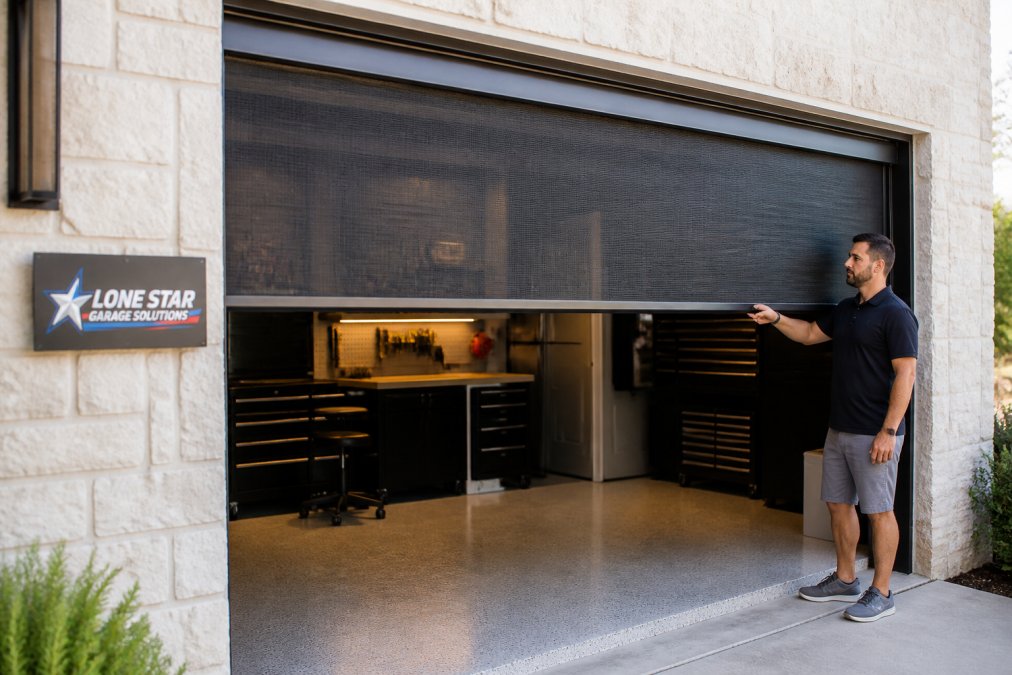
What sets it apart is the integrated passage door. Instead of rolling the whole screen up every time you walk in or out, you use a smaller door built into the panel.
Lone Star Garage Solutions is an authorized installer of Lifestyle retractable garage screens, and we size each system to your existing opening. Older garages with uneven framing usually work fine; the track mounts to the jamb, not the door itself.
Motorized Patio Screens for Garages: Maximum Heat Control
Motorized patio screens deliver the strongest heat rejection of any garage screen option. These systems use solar-rated mesh in an aluminum housing, and they deploy at the push of a button or from a remote.
The mesh itself does the work. Solar screens block a large share of radiant heat before it enters the garage, which keeps the slab and stored items cooler.
Templar motorized patio screens are a popular choice for this job because the housing mounts cleanly above the opening and the screen retracts out of sight. They also work on patios, so if you're screening both the garage and the back porch, one system type covers both.
The tradeoff is electrical work. Motorized units need a power source near the opening, and installation is not a weekend project.
Magnetic and Budget Garage Screens: What You Get
Magnetic and budget garage screens are the cheapest way to keep bugs out, and that's mostly what they do. They won't meaningfully lower garage temperature, but they cost a fraction of a retractable system. Understanding how they actually work, and how they fail, helps you decide whether they belong on your opening at all.
How the mechanism works. A magnetic screen is a mesh panel with magnets sewn into the center seam and along the perimeter.
- Wind is the primary killer. A deployed magnetic panel acts like a sail. Sustained gusts and spring storm fronts pull the perimeter tape loose, stretch the center seam, and eventually tear the mesh at the attachment points. Most budget panels are seasonal products for exactly this reason.
- Heat does not get blocked. Standard polyester and fiberglass mesh blocks bugs and some debris, but it does not reject radiant heat the way a solar-rated screen does. A west-facing garage with a magnetic panel still bakes.
- UV degrades the mesh. Polyester mesh fades and grows brittle under intense sun. Fiberglass holds up better but still loses tensile strength over a few seasons.
- The center seam wears out first. Every walk-through stresses the magnets and the stitching. High-traffic households see seam failure within a season or two.
What the common budget options look like:
- Entry-level magnetic panels: Lightweight mesh with magnetic closure. Installs in minutes with no tools. Limited life in high wind.
- Reinforced magnetic panels: Heavier magnetic strips and UV-resistant polyester mesh. Better visibility, but the strips need occasional re-seating.
- Heavyweight magnetic panels: Thicker mesh and stronger magnets than entry-level options. Still a seasonal product.
- Hook-and-loop frame kits: Fiberglass mesh sized to common opening dimensions with a Velcro-style perimeter frame. The most durable of the budget styles, but the frame strip collects dust and loses grip over time.
Garage Screen Installation Cost: DIY vs. Professional
Installation is where most buyers misjudge the real effort. The screen itself is only part of the equation; how it's mounted determines whether it lasts. This is also where the Texas climate and local rules change the calculus in ways most generic guides skip.
DIY makes sense when:
- You're installing a magnetic or hook-and-loop screen
- Your garage opening is square and the framing is solid
- You only need seasonal bug protection
- Your opening is sheltered from prevailing wind
Professional installation makes sense when:
- You're installing a retractable or motorized system
- The opening is out of square or the header needs blocking
- The opening faces the direction of your strongest prevailing winds
- You want the screen tied into your home's electrical for motorized operation
- You need the work warrantied
| Factor | DIY | Professional |
|---|---|---|
| Best suited to | Magnetic, hook-and-loop | Retractable, motorized |
| Time required | Under an hour | Half day or more |
| Main risk | Poor seal, short lifespan, wind damage | None if installed correctly |
| Wind resistance | Low | Engineered for the opening |
| Warranty | None | Workmanship covered |
| Electrical work | Not applicable | Handled by installer |
| HOA approval | Owner's responsibility | Often handled as part of the quote |
Lifestyle Garage Screens Benefits for Central Texas Homes
Lifestyle garage screens benefits go beyond bug control, and that's why they're the most requested system we install. The screen turns a garage from storage space into usable square footage.
How to Choose the Right Garage Screen for Your Home
Start with your primary goal, then match the screen type to it. Most buyers overthink this; the decision usually comes down to three questions.
1. What's the main problem?
- Bugs only → magnetic or hook-and-loop screen
- Heat and bugs → retractable or motorized solar screen
- Heat, bugs, and privacy → motorized screen with solar mesh
Frequently Asked Questions
What is the best garage screen for high-temperature climates?
For Texas heat, a motorized or retractable garage screen with solar-blocking mesh performs best. These systems block a significant share of radiant heat while keeping the garage ventilated. Magnetic curtains cost less but offer minimal heat reduction and wear out faster in high wind. If you want year-round performance, a professionally installed retractable system is the most reliable choice.
Are retractable garage screens better than magnetic curtains?
Retractable screens last longer, seal better against insects, and block more heat than magnetic curtains. Magnetic options are affordable and easy to install, but the closures degrade with heavy use and high wind. Retractable systems cost more upfront but deliver better durability and a cleaner look, especially for garages used daily.
Do garage screens help reduce indoor temperatures?
Yes. Screens with solar or heat-blocking mesh can lower garage ambient temperature noticeably by cutting radiant heat from the sun. Motorized systems with high-visibility mesh are particularly effective at rejecting radiant heat. The exact reduction depends on mesh type, sun exposure, and whether the garage is insulated. Pairing screens with attic ventilation improves results.
How much does garage screen installation cost?
Garage screen installation cost depends on the system type, garage size, and whether electrical work is needed for motorized units. Magnetic DIY kits are the least expensive, retractable systems fall in the middle, and motorized screens are the highest investment. Contact Lone Star Garage Solutions for a quote tailored to your garage.
Will a garage screen work with an older garage door frame?
Most retractable and motorized screens can be custom-fit to older garage openings, but the frame needs to be structurally sound and reasonably square. A professional installer will measure your opening and check for issues like rot or warping before recommending a system. In most cases, minor adjustments are enough to make it work.
A hot, bug-filled garage limits how you actually use the space. Lone Star Garage Solutions installs Lifestyle retractable garage screens and Templar motorized patio screens sized to your opening, with flexible financing on qualifying projects and same-day repair service when something needs attention. Get a quote from Lone Star Garage Solutions and turn your garage into a space you'll use year-round.